
Replaced Guesswork With Evidence Across a K-5 Product
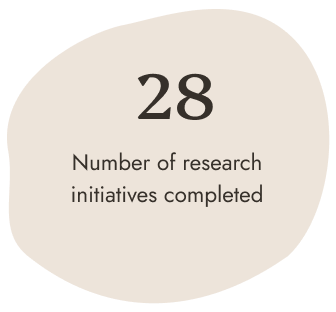
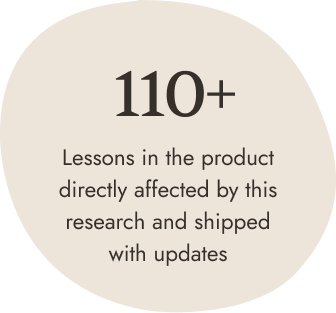
A research intake system I built from scratch to bring evidence-based decision making to a distributed team designing 110+ lessons across six grade levels.
Overview
Building a K-5 math product from scratch means making hundreds of small design decisions with real consequences. Can a kindergartner understand this button? Will a second grader notice when the problem changes? Does this interaction make sense to a child still learning how to use a device?
I built a research system to get real answers, and used those answers to change how the product got designed.
Role
Product Designer (Lead)
Duration
3 years
Team
UX Researcher
10+ Development Pods (Design, Dev, Content, Illustration, Editorial)
Skills
Research Integration
Organization UX
Design System
Systems Thinking
Leadership & Mentorship
Challenge & Solution

Designers were making judgment calls daily, often without data to support them.
Challenge
Pre-production research and industry best practices for young learners weren’t enough.
Accessibility standards existed, but gave no practical guidance for children.
Getting these interactions right was foundational to the product's launch success and long-term viability. Poor UX was a barrier to learning and a risk to adoption, renewal, and the districts’ contracts, which were worth millions of dollars.
Business Opportunity
I could see the full picture of where we were guessing, where design decisions weren't holding up, and where we were losing ground to content or development priorities.
How I Got To A Solution
I created a research intake system from scratch to bridge the gap between design questions and UX research capacity.
Solution
Tracked design questions that surfaced during development
Collaborated with UX Research team
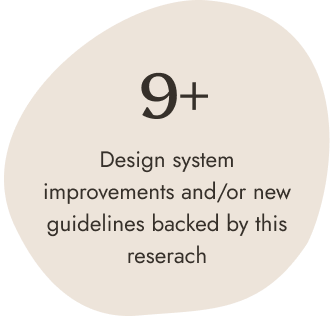
Translated findings into design guidelines
Maintained a “design debt database” to audit 110+ lesson and track where updates were needed
Design Challenges
I replaced assumptions with evidence, even when the evidence surprised us.

Challenge
The team had made a sweeping decision: add chevrons to draggable points whenever movement was limited to a single direction.
Then during a classroom observation, a student was visibly confused by a chevron on a draggable point. One observation. One student. The instinct on the team was to act on it. But one observation isn't a pattern, and making a product-wide change on a single data point felt like trading one guess for another.
I wanted real answers.
Solution
I worked with the UXR to design a test across multiple grades and multiple use cases, different types of draggable points, different contexts, different grade bands.
Chevrons were adding a layer of confusion.
I updated the guidelines to remove chevrons from draggable points across the board. Three pod designers working across six grades updated their work accordingly. This is what the system I built was for: replace assumptions with evidence, even when the evidence surprised us.
I had to make the case to product leadership that the impact justified the cost.
Challenge
Repeated practice screens, where students move from one problem to the next within the same screen, used dynamic text to signal a new problem had appeared. It was a common pattern across the product. It was also a known risk.
Changing text on screen is easily missed. For younger students especially, if the number or expression changes but nothing else does, they often don't notice. An observation confirmed it: students were confused, not realizing a new problem had loaded.
Solution
I designed a new best practice, with an interaction developer to make the change unmissable: elements disappearing and reappearing, new content sliding in, the screen actively signaling that something had changed.
The UXR tested it. The redesign worked. Students immediately understood when a new problem appeared. Several were excited by the animation. The confusion was gone.
But the work wasn't done. This pattern existed across dozens of already-built lessons, and updating them wasn't free. I had to make the case to product leadership that the impact justified the cost.
We weighed which lessons needed it most, updated the guidelines in the handbook with clear do/don't examples and design rationale, and prioritized the changes where student confusion was highest.
Outcomes
The research intake system changed how design decisions got made.
Questions that used to get answered by intuition or by whoever had the loudest opinion now had a path to real evidence.
Designers knew where to escalate.
Leadership had data to weigh against other priorities.
The UXR had a reliable filter for what the product actually needed tested.